
1099 Income Tax Planning: Your 2026 Contractor Guide
As an independent contractor, you pay the full 15.3% self-employment tax on 92.35% of your net earnings, covering both the employer and employee sides of Social Security and Medicare. No employer withholds taxes for you, so the entire burden of planning, saving, and paying falls on your shoulders. The good news: with the right system, you can cut your tax bill substantially and avoid the cash-flow panic that hits unprepared freelancers every April.
Here is what effective 1099 income tax planning covers:
-
Self-employment tax: 15.3% on net earnings multiplied by 92.35%, split between Social Security (12.4%) and Medicare (2.9%)
-
Quarterly estimated payments: required when you expect to owe $1,000 or more; due April 15, June 15, September 15, and January 15
-
Business expense deductions: home office, vehicle, equipment, software, health insurance, and professional services
-
Key forms: 1099-NEC, Schedule C, and Schedule SE
-
Tax savings rule of thumb: set aside 25–30% of every payment you receive to cover federal and state taxes
Table of Contents
-
How 1099 income tax planning works with your tax obligations
-
How to calculate quarterly taxes and avoid underpayment penalties
-
Which business entity structure saves you the most in taxes?
-
Income smoothing and deferral strategies to manage taxable income
How 1099 income tax planning works with your tax obligations
The 1099-NEC is the form clients use to report payments of $600 or more made to you during the year. You must report all self-employment income on your return, even when no 1099 arrives. The IRS does not care whether a client forgot to send the form.
Your net profit from Schedule C flows into Schedule SE, where self-employment tax is calculated. One immediate offset: you can deduct 50% of your self-employment tax from adjusted gross income, which lowers your income tax liability even though it does not reduce the SE tax itself. That deduction is worth real money, especially in higher income brackets.
A few more obligations to keep in mind:
-
Income tax brackets: your net profit from Schedule C is taxed at ordinary income rates, stacked on top of SE tax
-
State and local taxes: many states impose their own income tax on self-employment earnings; some cities add a local tax layer
-
Filing threshold: if your net earnings from self-employment reach the IRS filing threshold, you must file a return
-
1099-K: payment processors like PayPal and Stripe may also send this form for card and platform transactions
State taxes vary widely. A contractor in Texas pays no state income tax; one in California faces rates up to 13.3%. Factor your state’s rate into your savings plan from day one.
How to track and maximize your business expense deductions
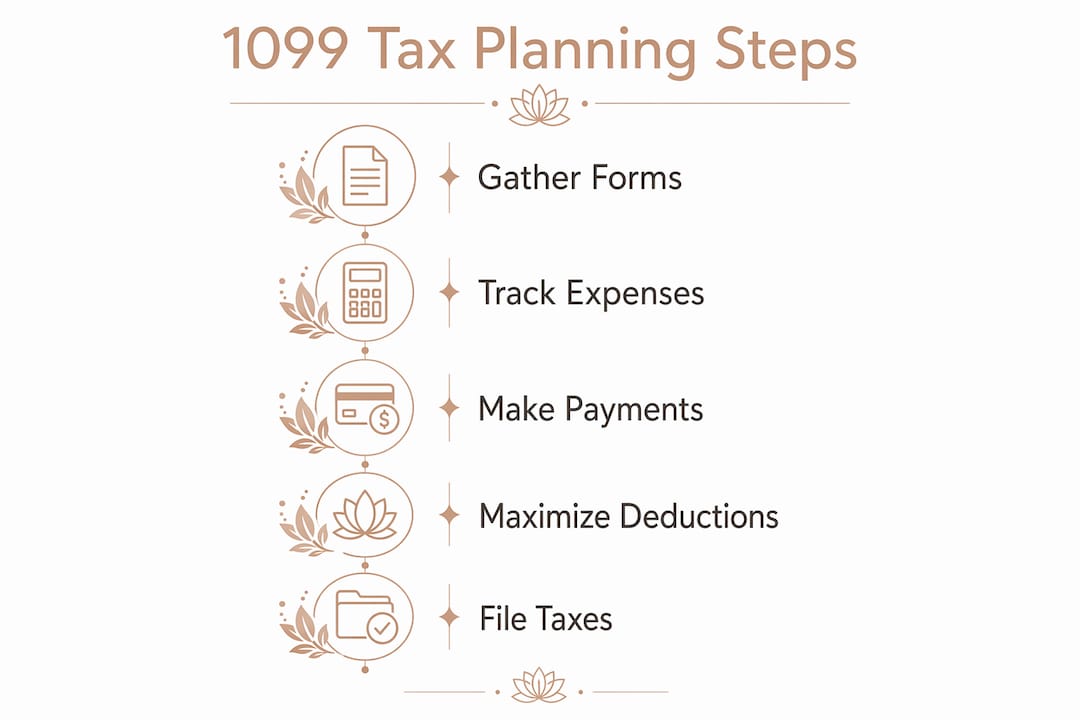
Every dollar of legitimate business expense reduces your taxable income, which cuts both income tax and self-employment tax. The IRS allows a broad range of deductible business expenses, and most contractors leave money on the table by missing categories they qualify for.
Common deductions worth tracking:
-
Home office: the simplified method allows $5 per square foot, up to 300 square feet; the space must be used regularly and exclusively for business
-
Vehicle: the standard mileage rate is 67 cents per mile (adjusted annually); keep a mileage log with dates, destinations, and business purposes
-
Equipment and software: computers, cameras, subscriptions, and tools used for work are fully deductible
-
Health insurance premiums: self-employed contractors can deduct 100% of premiums for themselves and their families
-
Professional services: accountant fees, legal fees, and business coaching are deductible
-
Travel and meals: business travel is fully deductible; meals are generally 50% deductible when business-related
Separating personal and business expenses is non-negotiable. Open a dedicated business checking account and use it exclusively for business transactions. Commingling funds is one of the fastest ways to trigger an audit and lose deductions you legitimately earned.
Section 179 lets you deduct the full cost of qualifying equipment in the year you buy it, rather than depreciating it over several years. For a contractor buying a $3,000 laptop, that means the full deduction hits this year’s return instead of being spread across five years.

Pro Tip: If you expect higher income this year than next, accelerate deductible purchases before December 31. Buying that new monitor or software subscription in December rather than January can shift the deduction to the higher-income year, where it saves more.
Record keeping, estimated taxes, and how to avoid audits
Organized records are the foundation of every other strategy in this guide. Real-time tracking of mileage, receipts, and expenses with dedicated apps reduces missed deductions and makes an audit far less stressful. Apps like QuickBooks Self-Employed, Wave, or even a well-maintained spreadsheet work well. The key is consistency, not the tool.
Quarterly estimated tax payments keep you compliant and protect you from penalties. The four deadlines are April 15, June 15, September 15, and January 15 of the following year. Miss them and the IRS charges underpayment penalties on the shortfall.
Practical steps for staying on track:
-
Safe harbor rule: pay either 100% of last year’s tax liability (110% if your prior-year adjusted gross income exceeded $150,000) or 90% of this year’s estimated liability, whichever is smaller, to avoid penalties
-
Set aside 25–30%: move that percentage from every client payment into a separate savings account the day it arrives
-
Use Form 1040-ES: the IRS worksheet inside this form helps you calculate each quarterly payment accurately
-
Keep receipts for everything: digital copies stored in a cloud folder work fine; the IRS accepts electronic records
Missing estimated payments triggers underpayment penalties calculated annually on the shortfall. Paying on time costs nothing extra. Paying late costs you a percentage of what you owed, every quarter it goes unpaid.
Clean documentation also reduces audit risk. The IRS looks for inconsistencies between reported income and lifestyle, unusually high deductions relative to income, and home office claims without clear business-use evidence. Detailed records answer those questions before they become problems.

Retirement planning and tax-advantaged savings options
Retirement accounts are one of the most powerful tools in a contractor’s tax plan. Contributions reduce your adjusted gross income, which can also unlock additional tax credits and reduce phase-out effects on other deductions, as the IRS notes for self-employed retirement plans.
Two accounts stand out for independent contractors:
-
Solo 401(k): the 2026 employee contribution limit is $23,500, plus employer contributions (as the business owner, you wear both hats), bringing the combined maximum to around $70,000
-
SEP-IRA: simpler to administer, with contributions up to 25% of net self-employment income; a strong choice if you want less paperwork
Health Savings Accounts add another layer. If you carry a qualified high-deductible health plan, you can contribute up to the IRS-set limits for individual or family coverage annually. HSA contributions are tax-deductible going in, grow tax-free, and come out tax-free for qualified medical expenses. That triple benefit is hard to match anywhere else in the tax code.
Timing matters with retirement contributions. You can make SEP-IRA contributions up to your tax filing deadline, including extensions, giving you flexibility to calculate the optimal amount after the year ends. Solo 401(k) employee contributions, however, must be elected by December 31 of the tax year.
How to calculate quarterly taxes and avoid underpayment penalties
The safest calculation method starts with your prior year’s total tax liability. If you paid $12,000 in federal taxes last year, divide by four and pay $3,000 each quarter. That satisfies the safe harbor rule and protects you from penalties even if your income jumps significantly this year.
When your income is unpredictable, estimate each quarter based on actual earnings. Add your projected net profit, apply the SE tax rate to 92.35% of that figure, add your estimated income tax, then divide by four. Recalculate each quarter as your income picture becomes clearer.
A few practical guardrails:
-
Overpaying is fine: any excess becomes a refund or credit toward next year’s first quarter
-
Underpaying is costly: the IRS charges interest on shortfalls from the original due date, not just at year-end
-
Irregular income months: in a slow quarter, still pay based on your annual projection, not just what you earned that quarter
For self-employed contractors with variable income, a self-employed affordability calculator can help you model cash flow alongside your tax obligations, which is useful when planning larger purchases or loan applications.
What tax credits are available to 1099 income earners?
Tax credits reduce your actual tax bill dollar for dollar, making them more valuable than deductions of the same size. Several credits are available to self-employed contractors.
The Qualified Business Income (QBI) deduction under Section 199A lets eligible contractors deduct up to 20% of qualified business income from taxable income. This is not a credit but functions similarly, and it applies to most sole proprietors and single-member LLCs below certain income thresholds.
Other credits worth reviewing:
-
Earned Income Tax Credit (EITC): available to lower-income self-employed filers; eligibility depends on net earnings and filing status
-
Child and Dependent Care Credit: if you pay for childcare while you work, a portion of those costs may qualify
-
Retirement Savings Contributions Credit (Saver’s Credit): lower-income contractors who contribute to a Solo 401(k) or SEP-IRA may qualify for a credit of up to 50% of contributions
-
Self-employed health insurance deduction: while technically a deduction, it reduces adjusted gross income in a way that affects credit eligibility across the board
Which business entity structure saves you the most in taxes?
Most contractors start as sole proprietors by default, reporting income on Schedule C. That works fine at lower income levels, but as net profit grows, the structure you operate under can change your tax bill meaningfully.
A single-member LLC offers liability protection but is taxed identically to a sole proprietorship by default. The tax savings come from entity elections, not the LLC itself.
The S-Corporation election becomes worth examining once net profit consistently exceeds around $70,000. As an S-Corp, you pay yourself a reasonable salary and take the remaining profit as a distribution. Only the salary portion is subject to self-employment tax. The distribution is not. For a contractor earning $120,000 in net profit, the difference between paying SE tax on all of it versus on a $60,000 salary can be several thousand dollars annually.
The tradeoff is real: S-Corps require payroll setup, quarterly payroll tax filings, and additional accounting costs. The net savings need to outweigh those costs before the election makes sense. A tax professional can run the numbers for your specific situation.
Income smoothing and deferral strategies to manage taxable income
Taxable income is not fixed. With planning, you can shift income and expenses between years to stay in lower brackets or qualify for credits that phase out at higher income levels.
Defer income: if you complete a project in December, consider invoicing in early January so the payment lands in the next tax year. This works best when you expect lower income next year.
Accelerate deductions: the flip side of deferral. If you expect higher income this year, pull deductible expenses forward. Pay your January software subscription in December, prepay professional memberships, or purchase equipment you planned to buy anyway.
Retirement contributions as a lever: a large SEP-IRA contribution in a high-income year can drop your adjusted gross income enough to qualify for credits or avoid a higher bracket entirely.
Smooth irregular income: contractors with feast-or-famine income cycles benefit from averaging strategies. Consistent retirement contributions and a disciplined quarterly tax payment system prevent the year-end scramble that leads to underpayment penalties and cash shortfalls.
Key Takeaways
Effective 1099 income tax planning requires understanding self-employment tax, making timely quarterly payments, maximizing deductions, and using retirement accounts to reduce taxable income each year.
| Point | Details |
|---|---|
| Self-employment tax rate | You owe 15.3% applied to 92.35% of your net earnings, covering both Social Security and Medicare. |
| Quarterly payment deadlines | Pay by April 15, June 15, September 15, and January 15 to avoid underpayment penalties. |
| Retirement contribution limits | Solo 401(k) employee contributions reach $23,500 in 2026, with a combined max around $70,000. |
| HSA triple tax benefit | 2026 HSA limits are $4,300 for individuals and $8,550 for families on qualifying high-deductible plans. |
| Lotus tax planning | Lotus provides contractor-focused tax planning and filing services to reduce liability and avoid penalties. |