
Depreciation in Taxes: A Plain-English Guide
Depreciation is a tax deduction that lets you recover the cost of business or income-producing property over its useful life, rather than writing off the full purchase price in the year you buy it. The IRS governs this through MACRS, Section 179, bonus depreciation, and Form 4562. Three things to know immediately:
-
Who can use it: Any individual or business that owns qualifying property used for business or income-producing purposes.
-
Primary benefit: Reduces taxable income each year, improving cash flow without an additional cash outlay.
-
Main trade-off: Depreciation taken now reduces your asset’s adjusted basis, which can trigger a taxable gain (recapture) when you sell.
Table of Contents
-
How depreciation is calculated: basis, class life, and methods
-
How depreciation affects your taxable income, cash flow, and eventual sale
-
Worked examples: equipment, a vehicle, and a rental property
What is depreciation in taxes, and which assets qualify?
Not every asset you buy for your business can be depreciated. The IRS sets four eligibility requirements: the property must be owned by you, used in a business or income-producing activity, expected to last more than one year, and have a determinable useful life.
Common qualifying assets include machinery, computers, office furniture, business vehicles (the business-use portion only), commercial buildings, and certain intangible property. What never qualifies is land. You can depreciate the building sitting on it, but not the dirt beneath it. Land improvements like fences, sidewalks, and parking lots are a different story — those can be placed in a depreciable class with their own recovery period.
Mixed-use assets require careful allocation. If you use a vehicle partially for business and partially for personal use, only the business-use portion of the vehicle’s cost enters your depreciation calculation. Keep a mileage log — the IRS expects documentation, not estimates.
Exclusions worth noting:
-
Personal-use property (your home, personal car, personal computer)
-
Inventory held for sale
-
Land (always excluded, no exceptions)
-
Assets placed in service and disposed of in the same tax year
How depreciation is calculated: basis, class life, and methods
The math follows a clear sequence. Get these five steps right and the rest falls into place.
-
Determine your basis. Start with the purchase price, then add freight, installation, and sales tax paid to get the asset into service. That total is your depreciable basis. A $20,000 machine with $800 in freight and $1,200 in installation has a $22,000 basis.
-
Identify the business-use percentage. If the asset is partly personal, multiply the basis by the business percentage before applying any depreciation rate.
-
Assign the correct property class. MACRS groups assets into recovery periods: 3, 5, 7, 10, 15, 20, 27.5, or 39 years, depending on asset type. Office furniture and most equipment land in classes with relatively short recovery periods. Residential rental property and nonresidential real property have longer recovery periods according to IRS classifications.
-
Choose your method. MACRS General Depreciation System (GDS) uses declining-balance switching to straight-line. The Alternative Depreciation System (ADS) uses straight-line over a longer life. Section 179 and bonus depreciation let you expense all or most of the cost in year one.
-
Apply the half-year or mid-month convention. Most personal property uses the half-year convention (treated as placed in service at mid-year). Real property uses the mid-month convention. If more than 40% of your personal property is placed in service in the fourth quarter, the mid-quarter convention applies instead.
Quick method comparison
| Method | Timing | Best for |
|---|---|---|
| MACRS GDS (declining-balance) | Accelerated front-loaded | Most business personal property |
| Straight-line (ADS or elected) | Equal annual deductions | Long-hold assets, AMT planning |
| Section 179 expensing | Full cost in year one | Cash-flow-priority purchases |
| Bonus depreciation | Large percentage in year one | High-value equipment, vehicles |
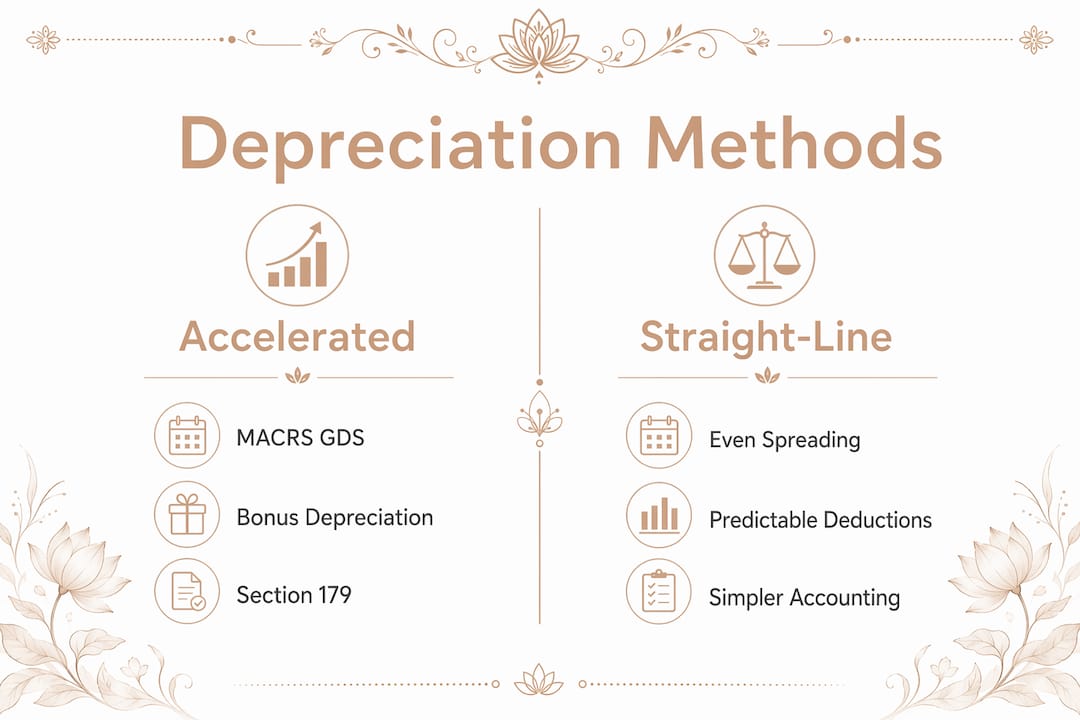
Accelerated methods front-load deductions, which is worth more in present-value terms. Straight-line spreads them evenly, which can be useful when you expect higher income (and higher tax rates) in future years.

How depreciation affects your taxable income, cash flow, and eventual sale
Each year you claim depreciation, your taxable income drops by that amount. On a piece of equipment with a 7-year MACRS schedule, the year-one deduction under GDS is roughly 14.29% of basis. At a typical effective tax rate, this results in a tax saving that improves cash flow in the first year — real cash you keep.

The long-term picture is more nuanced. Every dollar of depreciation you claim reduces your asset’s adjusted basis. When you sell, the IRS calculates your gain as sale price minus adjusted basis. The portion of that gain attributable to prior depreciation deductions can be taxed as ordinary income under the recapture rules — up to 25% for real property (unrecaptured Section 1250 gain) and at ordinary rates for personal property (Section 1245 recapture). For a deeper look at how this plays out at sale, the tax implications of selling property matter as much as the deductions you took along the way.
Key impacts at a glance:
-
Reduces taxable income annually without a cash outflow in that year
-
Improves near-term cash flow, especially with Section 179 or bonus depreciation
-
Reduces adjusted basis, increasing potential taxable gain on sale
-
Accelerated methods increase recapture exposure compared to straight-line
-
Alternative Minimum Tax (AMT) can limit or eliminate the benefit of accelerated depreciation for some taxpayers — ADS straight-line is the AMT-safe method
The time-value argument for accelerating deductions is real: a dollar saved today is worth more than a dollar saved in year seven. But if you plan to sell the asset soon, the recapture tax can partially offset those early savings.
How to claim depreciation on your U.S. tax return
Filing correctly matters as much as calculating correctly. Errors in basis, placed-in-service dates, or missing Form 4562 can complicate future gain/loss calculations and raise audit risk.
Filing checklist:
-
Form 4562 is required when you place new depreciable property in service, claim a Section 179 election, or report depreciation on listed property (vehicles, computers used partly for personal purposes). It also covers amortization.
-
Placed-in-service date is the date the asset is ready and available for its intended use — not necessarily the date you paid for it or received it.
-
Listed property rules apply to vehicles, certain computers, and other property that can easily be used personally. These require detailed business-use documentation and impose stricter limits.
-
Conversion from personal to business use: Section 179 is not available for property converted from personal use. MACRS applies, and the depreciable basis is the lesser of adjusted basis or fair market value at the date of conversion, per IRS Publication 946.
-
Improvements vs. repairs: Routine repairs are deducted in the year incurred. Improvements that add value, extend useful life, or adapt the property to a new use must be capitalized and depreciated separately.
Records to keep:
-
Purchase invoices showing price, freight, installation, and sales tax
-
Placed-in-service date documentation
-
Business-use logs (mileage logs for vehicles, usage records for mixed-use equipment)
-
Depreciation schedules updated each year
For self-employed taxpayers, the self-employment tax deductions guide covers how depreciation interacts with Schedule C and other deductions.
Worked examples: equipment, a vehicle, and a rental property
1. Manufacturing equipment (5-year MACRS)
A small manufacturer buys a CNC machine for $18,000, pays $700 in freight and $300 in installation. Basis = $19,000. The machine is 100% business use, placed in service in March, and falls in the 5-year MACRS class. Under GDS with the half-year convention, the year-one rate is 20.00%.
2. Business vehicle (mixed use)
A consultant buys a car for $30,000. Business use is 70%. Adjusted basis for depreciation = $21,000. The vehicle falls in the 5-year class. Year-one MACRS at 20% on $21,000 = $4,200. Note: luxury auto limits under IRC §280F cap annual depreciation for passenger vehicles — the deduction may be lower than the MACRS calculation suggests. Always check the current-year IRS limits.
3. Residential rental property (27.5-year straight-line)
An investor purchases a rental house for $275,000. The IRS requires allocating between land (not depreciable) and structure. If land is valued at $50,000, the depreciable basis is $225,000. Annual depreciation = $225,000 ÷ 27.5 = $8,182 per year. Section 179 and bonus depreciation generally do not apply to residential rental buildings themselves, though certain qualified improvement property within the building may qualify.
Lotus tax-planning tips: when to accelerate vs. defer
The choice between Section 179, bonus depreciation, and standard MACRS is not just a math problem — it is a cash-flow and strategy decision. The IRS guidance on small business depreciation frames it as a planning tool, not just a compliance requirement.
Accelerate (Section 179 or bonus) when:
-
Your business has strong taxable income this year and you want to reduce it now
-
Cash flow is tight and the immediate tax savings matter more than future deductions
-
You expect your tax rate to be lower in future years
-
The asset has a short expected hold period (less recapture exposure)
-
You are in an early growth phase and need to reinvest savings quickly
Defer (straight-line MACRS) when:
-
Income is low this year and you expect higher income later
-
You are subject to AMT and accelerated depreciation triggers additional tax
-
The asset will likely be held long-term, reducing recapture risk
-
You want predictable, even deductions for financial reporting purposes
Pro Tip: Keep a running depreciation schedule for every asset from day one. When you eventually sell, that schedule tells you the adjusted basis instantly — without it, reconstructing years of deductions under audit pressure is painful and error-prone.
Equipment financing decisions also interact with depreciation timing. If you are financing a purchase rather than paying cash, the equipment financing planning perspective on cash-flow timing is worth reviewing alongside your depreciation election.
When to bring in a tax professional:
-
Converting personal property to business use (basis rules are strict)
-
Large year-end purchases that could trigger the mid-quarter convention
-
Multi-state operations (state depreciation rules often differ from federal)
-
Transactions involving listed property or luxury vehicles
-
Any year where Section 179 or bonus depreciation elections significantly change your tax picture
Key Takeaways
Tax depreciation lets you recover the cost of qualifying business property over its useful life through annual deductions governed by MACRS, Section 179, bonus depreciation, and Form 4562.
| Point | Details |
|---|---|
| Eligibility basics | Property must be owned, used for business, last more than one year, and have a determinable useful life. |
| Core methods | MACRS GDS is the standard; Section 179 and bonus depreciation allow full or near-full year-one expensing. |
| Recovery periods | Residential rental: 27.5 years; nonresidential real property: 39 years; most equipment: 5 or 7 years. |
| Recapture risk | Depreciation reduces adjusted basis; gain on sale may be taxed as ordinary income under recapture rules. |
| Lotus next step | Gather invoices and placed-in-service dates, then consult with us before making large Section 179 or bonus elections. |
The depreciation detail most taxpayers overlook
Most people focus on the deduction and forget the exit. Depreciation is a loan from your future self: you get the tax savings now, but the IRS collects part of it back when you sell through recapture. The taxpayers who get hurt are the ones who took aggressive Section 179 elections in year one, then sold the asset two years later without accounting for the recapture tax in their sale price negotiation.
The other thing worth saying plainly: the placed-in-service date is not the purchase date. Buying equipment in December and leaving it in a box until January means your deduction starts in January. That distinction has cost more than a few taxpayers a full year of depreciation they thought they had locked in.
Record-keeping is where most depreciation problems start. Save every invoice, note the date the asset went into actual use, and log business mileage from day one. A depreciation schedule is not just a tax form — it is a financial asset that tells you exactly what you owe the IRS if you sell.
Authoritative sources for deeper reading
The rules around depreciation change with legislation, and the IRS publishes the definitive guidance. These are the primary sources to consult:
-
IRS Topic No. 704, Depreciation: The IRS’s own plain-language overview of what depreciation is and who qualifies.
-
IRS Publication 946, How To Depreciate Property: The comprehensive official guide covering MACRS tables, Section 179, bonus depreciation, listed property, and conversion rules.
-
IRS Form 4562 and Instructions: The form you file to claim depreciation, amortization, and Section 179 elections.
-
IRS Depreciation FAQs: Answers to common questions on basis, class lives, and MACRS conventions.
-
Tax Foundation TaxEDU Glossary — Depreciation: A concise, policy-focused explainer on cost recovery and the present-value argument for immediate expensing.
A note on state taxes: Federal MACRS rules do not automatically apply at the state level. Many states decouple from bonus depreciation or Section 179 and require separate state depreciation schedules. If you operate in multiple states or have significant capital purchases, verify your state’s conformity rules with a tax professional or your state’s department of revenue.