
What Is Tax Planning? A Guide for Individuals and Businesses
Tax planning is defined as the year-round, proactive process of legally organizing your finances to minimize your tax liability before the calendar year closes. Unlike tax preparation, which files what already happened, tax planning shapes what will happen. The IRS recognizes a wide range of legal strategies, from income deferral to deduction bunching, that reduce what you owe without crossing into illegal territory. Whether you run a business or earn a salary, understanding how to plan taxes gives you control over one of your largest annual expenses.
What is tax planning, and how does it differ from tax preparation?
Tax planning is a proactive, year-round process of legally organizing your financial affairs to reduce future tax liabilities. Tax preparation, by contrast, is a seasonal task: you gather documents, file a return, and report what already occurred. The critical difference is timing. Planning happens before December 31st. Preparation happens after.
Think of it this way. Tax preparation is the photograph. Tax planning is deciding what to wear before the picture is taken. Once the year ends, most opportunities to influence your tax bill disappear. Strategies like deferring income into the next tax year, accelerating deductions, or maximizing retirement contributions all require action while the year is still open.

Tax planning also differs from tax evasion. Tax evasion is illegal misrepresentation of income or expenses. Tax planning uses every legal provision the tax code allows. CPAs and Tax Attorneys are the licensed professionals authorized to provide specific tax advice. Not every financial advisor holds that authority, so choosing the right professional matters.
What are the core tax planning strategies for individuals and business owners?
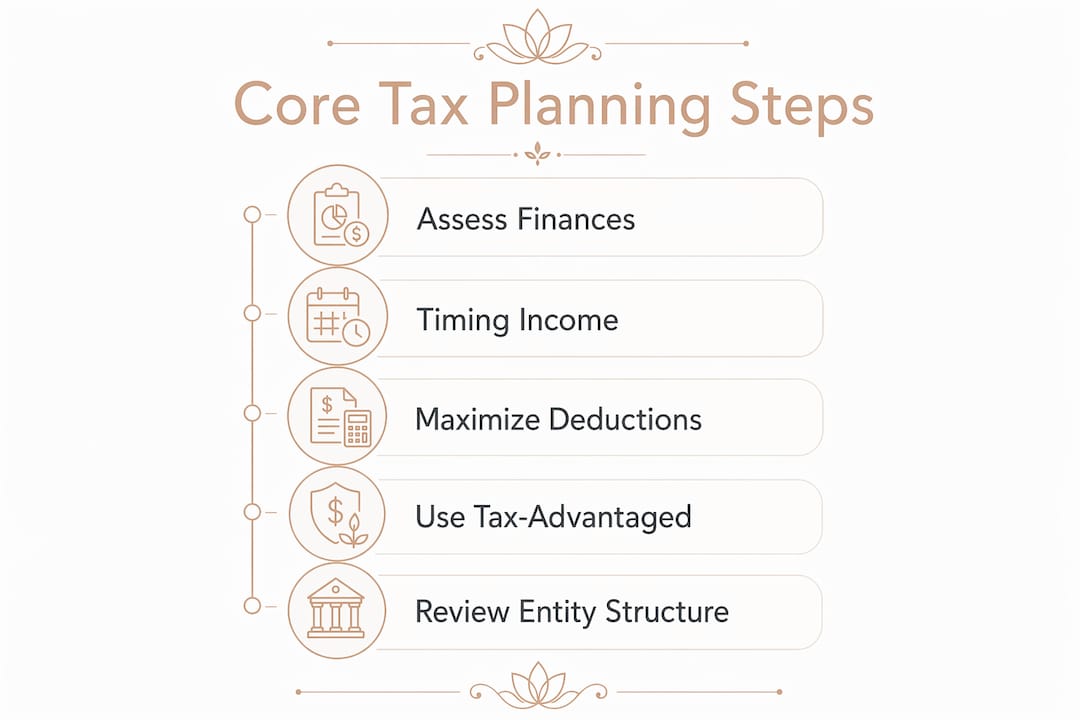
A small set of levers drives most of the tax savings available to individuals and business owners. Core tax planning strategies include timing income and deductions, using tax-advantaged accounts, bunching deductions, and structuring your business or compensation correctly.
Timing income and deductions
Timing is the most powerful lever in tax planning. If you expect to be in a lower tax bracket next year, deferring a bonus or freelance payment into January can reduce your current-year tax bill. The reverse works too: if you expect higher income next year, accelerating deductions into the current year locks in a bigger benefit now.
Tax-advantaged accounts
Contributions to a 401(k), Traditional IRA, or Health Savings Account (HSA) reduce your taxable income dollar for dollar, up to annual IRS limits. A self-employed person who maximizes a SEP-IRA contribution can shelter a significant portion of net earnings from federal income tax. These accounts do not eliminate taxes permanently, but they defer or reduce them in ways that compound over time.
Bunching deductions
The standard deduction for 2026 is high enough that many taxpayers cannot beat it in any single year. Bunching solves this by concentrating two years of charitable contributions, medical expenses, or property taxes into one calendar year. You itemize that year and take the standard deduction the next. The total deduction over two years exceeds what you would have claimed by splitting them evenly.
Entity and compensation structure for business owners
Business owners have more levers than employees. Choosing between a sole proprietorship, S corporation, or LLC affects self-employment tax exposure. Paying yourself a reasonable salary through an S corp, for example, can reduce the portion of income subject to self-employment taxes. Self-employment tax deductions are a separate category worth reviewing alongside entity structure decisions.
Pro Tip: Review your entity structure every two to three years. Business growth often creates a point where switching from a sole proprietorship to an S corp generates meaningful tax savings.
How does tax planning integrate with overall financial planning?
Tax planning is not a standalone activity. Without a unified strategy, fragmented short-term tax decisions often result in paying more taxes than necessary over time. The most effective approach weaves tax planning into every major financial decision, from investment selection to retirement timing to estate transfers.
Here is where integration matters most:
-
Investments: Holding appreciated assets for more than one year qualifies gains for long-term capital gains rates, which are lower than ordinary income rates. Asset location, meaning which accounts hold which investments, also affects your annual tax bill.
-
Retirement planning: The sequence of withdrawals from taxable, tax-deferred, and tax-free accounts in retirement determines your effective tax rate across decades. Planning this sequence early produces compounding benefits.
-
Estate planning: Gifting strategies, stepped-up basis rules, and trust structures all carry tax consequences. Coordinating these with your CPA and estate attorney prevents costly surprises.
-
Cash flow management: A strong tax planning system considers cash flow and risk control alongside tax minimization. Quarterly reviews and adjustments for variable income or life events keep your plan current.
Licensed tax practitioners, specifically CPAs, Enrolled Agents, and Tax Attorneys, have the legal authority to provide specific tax advice. Your tax filing status also directly affects which strategies apply to you, so confirming your status before implementing any plan is a necessary first step.
What are practical tips for year-round tax planning?
Year-round tax planning reduces surprises and improves outcomes. The IRS and tax professionals consistently recommend ongoing review rather than a single annual scramble. Here is a practical routine that works for both individuals and business owners:
-
Review your withholding every January. Life changes like marriage, a new job, or a side business affect how much tax you should withhold. Adjusting your W-4 early prevents a large bill or an unnecessarily large refund at filing time.
-
Track income and expenses monthly. Business owners especially benefit from monthly bookkeeping. Waiting until December to categorize a year’s worth of transactions leads to errors and missed deductions.
-
Perform a midyear tax checkup in June or July. Compare your year-to-date income against last year. If income is higher than expected, accelerate deductions or increase retirement contributions before year-end.
-
Make year-end decisions before December 31st. Charitable contributions, retirement account contributions, and capital loss harvesting all require action before the calendar year closes. Waiting until January is too late.
-
Keep organized records throughout the year. Receipts, mileage logs, and business expense records are far easier to maintain in real time than to reconstruct at filing time. Digital tools like expense tracking apps reduce this burden significantly.
-
Consult a licensed tax professional at least once a year. A CPA or Enrolled Agent can identify opportunities you would not find on your own, particularly for business owners managing multiple income streams.
Pro Tip: Set a calendar reminder for October 1st each year to schedule a year-end tax planning meeting. That gives you three months to act on any recommendations before the December 31st deadline.
The benefits of tax planning compound over time. A single year of proactive decisions might save hundreds of dollars. A decade of consistent planning can save tens of thousands, particularly for business owners whose tax exposure grows with their income.
What common misconceptions and pitfalls should you avoid?
The biggest misconception about tax planning is that it happens during filing season. Many taxpayers miss the window to influence their tax results because they wait until April to think about taxes. By then, the year is over and the opportunities are gone.
A second misconception is that tax planning is only for wealthy people. Tax planning is accessible at all income levels. Contributing to a Roth IRA, claiming the Earned Income Tax Credit, or simply adjusting withholding are all forms of tax planning available to middle-income earners.
Other common pitfalls include:
-
Relying on unlicensed advisors. Not every person who calls themselves a tax advisor is legally authorized to give specific tax guidance. Only CPAs, Enrolled Agents, and Tax Attorneys carry that authority.
-
Ignoring timing deadlines. Retirement contributions, estimated tax payments, and charitable gifts all have hard deadlines. Missing them eliminates the tax benefit entirely.
-
Failing to plan for major financial events. Selling a business, receiving an inheritance, or exercising stock options can create large, unexpected tax bills if you do not plan in advance.
-
Mismanaging cash flow. Poor tax planning leads to underpayment penalties and cash shortfalls at filing time, particularly for self-employed individuals with variable income.
“Tax planning is not about chasing every possible deduction at any cost. It is about making informed, legal decisions throughout the year so that your tax bill reflects your actual financial situation, not a missed opportunity.”
Year-round planning is the single most effective way to avoid these pitfalls. Filing season is for reporting. The rest of the year is for planning.
Key Takeaways
Tax planning is a year-round, legal process that requires action before December 31st, and consistent attention to income timing, deductions, account selection, and professional guidance produces the greatest financial benefit.
| Point | Details |
|---|---|
| Planning vs. preparation | Tax planning happens before year-end; preparation files what already occurred. |
| Core strategies | Timing income, bunching deductions, and using tax-advantaged accounts do most of the work. |
| Professional guidance | Only CPAs and Tax Attorneys are legally authorized to give specific tax advice. |
| Year-round routine | Monthly tracking, a midyear checkup, and a december review prevent costly surprises. |
| Accessible to everyone | Tax planning applies at all income levels, not just for high earners or large businesses. |
Tax planning is worth more than most people realize
I have worked with individuals and business owners across a wide range of income levels, and the pattern is consistent. The people who save the most on taxes are not the ones with the most complex strategies. They are the ones who pay attention throughout the year.
The most overlooked opportunity I see is the midyear checkup. Most people never do one. They file in April, forget about taxes until the following march, and then scramble. A single conversation in July can identify whether you need to increase retirement contributions, harvest a capital loss, or adjust estimated payments. That conversation takes an hour and can save thousands.
The second thing I would push back on is the idea that tax planning requires a complicated setup. Knowing the main levers, timing, account type, entity structure, and deduction bunching, and applying them consistently is enough for most people to see real results. Complexity is not the goal. Consistency is.
If you are a business owner, your entity structure deserves a fresh look every few years. Growth changes the math. What made sense as a sole proprietor at $80,000 in revenue may cost you significantly more in self-employment taxes at $300,000. A CPA who specializes in business tax planning will spot that inflection point before it becomes expensive.
FAQ
What is the difference between tax planning and tax preparation?
Tax planning is a proactive, year-round process of legally reducing your tax liability before the year ends. Tax preparation is the seasonal task of filing a return to report what already happened.
Is tax planning only for high-income earners?
Tax planning applies at every income level. Strategies like contributing to a Roth IRA, adjusting withholding, and claiming available credits are available to middle-income earners and business owners alike.
When should I start tax planning for the year?
Tax planning should begin in january and continue throughout the year. The most valuable decisions, including income deferral and deduction bunching, require action before december 31st.
Who is qualified to provide tax planning advice?
CPAs, Enrolled Agents, and Tax Attorneys are the licensed professionals legally authorized to provide specific tax advice. Not all financial advisors carry this authority.
What happens if I skip tax planning and only do tax preparation?
Skipping tax planning means you lose the ability to influence your tax bill before the year closes. Most strategies require action during the tax year, and waiting until filing season is too late to apply them.